
 |
Peripheral Artery Disease exists on a spectrum. Some patients have no obvious symptoms. Others develop leg pain while walking. At the most advanced end of the spectrum is chronic limb-threatening ischemia, or CLTI—the modern term for what many patients and clinicians still call critical limb ischemia, or CLI.
CLTI occurs when PAD reduces blood flow so severely that a foot or leg develops ischemic rest pain, a wound that will not heal or gangrene. The Global Vascular Guidelines define CLTI as PAD accompanied by rest pain, gangrene or a lower-extremity ulcer lasting longer than two weeks.
This is not simply “poor circulation.” CLTI is a time-sensitive condition associated with limb loss, cardiovascular events, impaired quality of life and mortality. All patients with suspected CLTI should receive urgent evaluation by a vascular specialist.
“A wound is not simply a wound when blood flow is inadequate. Until circulation has been assessed, we may be treating the surface while missing the reason the tissue cannot heal.” — William B. Harris, DO, FACS, RPVI®
What Does Ischemic Rest Pain Feel Like?
Claudication generally appears while walking and improves with rest. Ischemic rest pain is different.
It may occur in the forefoot or toes while a patient is sitting or lying down. It often becomes worse at night when the leg is level with the heart. Some patients obtain temporary relief by hanging the foot over the side of the bed or sleeping in a chair because gravity can help the limited blood supply reach the foot.
Rest pain may be confused with neuropathy, arthritis, gout or a back condition. Neuropathic and ischemic pain can also exist together, especially in people with diabetes.
Persistent foot pain therefore deserves a complete history, physical examination and objective circulation testing rather than an assumption about its cause.
Foot-Wound Signs That Require Attention
A small blister, callus or toenail injury can become dangerous when blood flow is inadequate. Patients and caregivers should watch for:
- A sore that remains open longer than two weeks
- Increasing or foul-smelling drainage
- Darkening skin
- Redness spreading around a wound
- A cool or unusually pale foot
- Loss of skin or deeper tissue
- Black discoloration or gangrene
- Increasing pain or swelling
Infection can accelerate tissue damage, but antibiotics alone cannot correct an arterial blockage. Successful healing frequently requires both infection control and enough blood flow to deliver oxygen, nutrients and medications to the affected tissue.

Why Diabetes and Kidney Disease Increase the Risk
Diabetes and chronic kidney disease raise the stakes. Neuropathy may hide pain, allowing a severe wound to develop without dramatic symptoms. Both conditions are also associated with arterial calcification.
THE SAGE GROUP reported in 2025 that more than 3.5 million people with CLI have calcified lower-limb arteries. Its research links medial arterial calcification strongly with aging, diabetes and chronic kidney disease and notes that calcification can increase the complexity of revascularization.
Calcification also matters during testing. A stiff, non compressible artery may create an ankle pressure that appears normal or abnormally high even though blood flow to the foot is impaired.
How CLTI Is Evaluated
The evaluation begins with the patient, not the image.
A vascular specialist reviews the timing of symptoms, walking ability, wound duration, prior procedures, medications and conditions such as diabetes, kidney disease and heart disease. The physical examination includes:
- Skin color and temperature
- Arterial pulses
- Wound location and depth
- Evidence of tissue loss
- Swelling or infection
- Sensation and foot structure
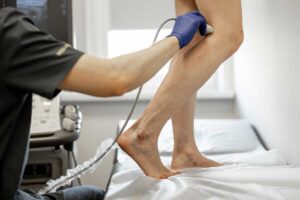
A resting ABI is useful for many patients, but suspected CLTI may require toe pressures, a toe-brachial index, pulse-volume waveforms, transcutaneous oxygen measurements or skin-perfusion pressure. These tests help determine whether enough blood is reaching the tissue to support healing. Duplex ultrasound and anatomic imaging may then be used to locate disease and plan treatment.
For complex below-the-knee and foot disease, imaging the complete arterial pathway can be essential.
Why Time Matters
CLTI should not be treated as a routine wound-care problem. The Society for Vascular Surgery recommends urgent specialist referral for suspected CLTI. The 2024 multisociety PAD guideline recommends revascularization when feasible to minimize tissue loss, heal wounds, relieve pain and preserve a functional limb.
Urgent evaluation does not mean every patient receives the same procedure.
Some patients first require drainage of an infection, debridement or stabilization of another medical problem. Others need rapid restoration of blood flow. The correct sequence depends on:
- The severity of infection
- The amount of tissue loss
- The location of the arterial blockage
- The likelihood that the tissue can heal
- The patient’s overall health and goals

How Blood Flow May Be Restored
Treatment may involve endovascular therapy performed through a small access site, open bypass surgery or a combination of the two.
Endovascular options may include angioplasty, stenting, plaque-modification techniques and specialized methods for disease below the knee or into the foot. Bypass surgery may be the most durable option for selected patients with suitable anatomy and an appropriate vein conduit.
Modern clinical trials reinforce that there is no single procedure that is best for every CLTI patient. BEST-CLI found an advantage for bypass in certain patients who had an adequate great saphenous vein, while BASIL-2 favored an endovascular-first strategy in a population requiring below-the-knee revascularization. These findings demonstrate why anatomy, vein availability, surgical risk, local expertise and patient goals must guide the treatment plan.
Limb Preservation Requires a Team
The Amputation Prevention Symposium is organized around multidisciplinary CLTI care, bringing together vascular surgery, interventional specialties, podiatry, wound care, nursing and vascular-laboratory professionals.
That model reflects what complex limb preservation requires. Diagnosis, infection treatment, wound care, pressure relief, revascularization, medical risk reduction and surveillance must work together rather than occur in isolation.
VIC identifies itself as the region’s only Critical Limb Center and was founded as a Regional Amputation Prevention Center. Its board-certified vascular surgeons and advanced practice providers care for PAD and CLTI using open and endovascular options supported by accredited vascular testing and rapid-access pathways.
Rest pain, gangrene and a foot wound that will not heal are not symptoms to watch for another month. They require prompt vascular evaluation.
A timely circulation assessment cannot guarantee that every limb can be saved, but it creates the best opportunity to understand the disease, consider appropriate treatment and make an informed decision before tissue loss progresses.
About the Author
William B. Harris, DO, FACS, RPVI®, is a board-certified vascular and endovascular surgeon at VIC. His clinical focus includes PAD, critical limb ischemia, aneurysmal disease, carotid disease and complex circulation disorders. Dr. Harris is a fellow of the American College of Surgeons and the Society for Vascular Surgery and previously served as a surgeon in the United States Air Force.